
White Line Fever
On my newfound love of audiobooks and reading Maaza Mengiste's The Shadow King

In Magnolia Electric Company’s “Leave the City,” the late Jason Molina croons “half my life’s spent on a highway/that’s half my life I didn’t choose.” It’s not exactly the same kind of long lonely road that I travel up and down I-95 on my hour-long commutes to and from work, but nonetheless I relate to that song so much that it’s become one of my go-to interstate karaoke jams. When I’m not living out my rock n roll fantasies crooning along with sad bastards like Molina, that long, lonesome highway is where I get a lot of reading done.
Since I don’t have a self-driving car or a death wish, I am, of course, referring to audiobooks. Notice that I don’t put quotations around the word reading here. I don’t want to get into a fray that’s been beaten to death on both sides by internet trolls and literacy advocates, but I absolutely think that audiobooks “count” as reading and anyone who tells you otherwise is generally a miserable little gatekeeper who ought to be reading instead of getting all up in other folks’ business. That said, the discourse around audiobooks tends, as Colton Cauthen writes in this thoughtful exploration of the subject, “toward the ditches,” meaning that it’s driven by extreme viewpoints and rage bait. Of course audiobooks are a valid way to experience books. Obviously, they’re an invaluable resource for visually impaired people, and when experienced readers are done listening to a book, they can mull it and discuss it with just as much authority as if they’d sat down and read it. For my purposes, since I spend almost eight hours a week on the highway, audiobooks allow me to read WAY more books than I would otherwise, and there’s no way that’s a bad thing. But of course there are differences in the way we internalize books when we listen to them rather than reading text even if they both have their strengths and weaknesses and their respective places in most readers’ lives.
I find that some books work better for me via audiobook than others. Length is a factor; it can be harder to maintain momentum and sustain interest in longer books in this format. Books with huge ensemble casts of characters and and names to keep up with or lots of time-period hopping can be difficult for me in audio format as well. But the one factor that weighs most heavily for me is the quality of the narration. When I (finally) delved into Ursula K. Leguin’s Earthsea series a few years back, I was so engrossed by Harlen Ellison’s narration I missed my interstate exit and was nearly late for work. I generally don’t care for a high level of voice acting (just read the text, please) but Ellison’s animated delivery was spellbinding, and it really worked with the subject matter. Then there’s the opposite side of the coin. I don’t want to throw anyone under the bus, so I won’t name names, but there’s one prolific audiobook reader who’s voice irks me so much that I all but refuse to read books that feature them as a narrator.
It’s not uncommon for me to DNF an audiobook after a few chapters because the narration gets under my skin for one reason or another. With Maaza Mengiste’s The Shadow King, though, I had an unusual problem. This was a book that was somewhat difficult for me as an audiobook not because of its length (a fairly long, but not behemoth 16 hours) or an unmanageable cast of characters or a bad narrator. Quite the opposite; this was an audiobook made challenging because the narrator was perhaps too good. Robin Miles’ narration was great, tastefully treading the line between voice acting and more straightforward reading, giving voice to Mengiste’s poetic prose with aplomb. But that prose was so poetic, Miles’ voice so lilting and soothing, there were times I had to stop and rewind after finding I’d drifted off on the sound of it, interstate miles flying by while the narration was like ambient music soothing the beasts in my head even when the subject matter was heavy. Let me be clear: this is MY failing, not the novel’s, and certainly not Miles’. She is a first-class audiobook narrator, one of the best around, and she did a great job narrating this challenging and thorny novel despite my tendency to lose the thread of the story listening to her siren song.
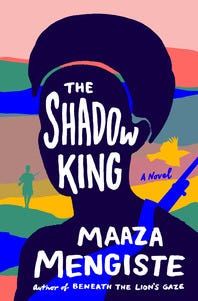
Set during the Italian invasion of Ethiopia prior to WWII, The Shadow King, like a lot of the books I’ve read or penciled in as TBR for this project, explores the legacy of colonialism and seeks to center the role of women in times of strife. Though it hops around in third-person points-of-view that follow a handful of expertly drawn characters, it focuses most sharply on Hirut, an orphaned servant woman who evolves into a soldier in the Ethiopian militia fighting the Italians. Hirut, who is, according to Mengiste’s postscript, loosely inspired by the author’s grandmother, is fierce and determined. She rises through the ranks and eventually becomes the bodyguard of the titular shadow king, a peasant made up to look like Emperor Haile Selassie, who has fled to England, in an attempt to rally the Ethiopian resistance. The struggle against the Italian invasion, though central to the action of the novel, takes something of a backseat to Mengiste’s exploration of Hirut’s complicated relationships, most notably with Aster, the wife of Kidane, the aristocratic militia leader whose house Hirut serves. Early in the novel, Aster beats Hirut mercilessly for trying to run away, but things change when they are both taken prisoner by Italian forces.
Speaking of Italian forces, Mengiste also gives life to two memorable characters on the other side of the struggle. Colonel Carlo Fucelli could easily have been a cartoonish, one-dimensional villain in the hands of a lesser writer. Though he remains a clear antagonist whose cruelty knows no bounds, we get enough of his backstory with an overbearing father to find a glimmer of empathy for him even as we cheer his eventual downfall. There’s also his fraught relationship with Ettore Navarra, an Italian soldier and photographer whom Fucelli forces to document the sadistic treatment of Ethiopian prisoners. Fucelli takes Navarra, whose father is Jewish, under his wing and attempts to protect him from the military census ordered by Mussolini to round up all the Jews serving in the Italian army, a proposition that Navarra something of a double pariah, despised by the Ethiopians, even after he stays in the country until the revolution of the 1970’s epilogue, and subject to a witch hunt by his own countrymen.
All told, it’s an unflinching yet multifaceted look at the brutal conflict that absolutely refuses to pander to easy answers or simplistic depictions. Despite my tendency to drift off the thread of the audiobook from time to time on the highway, this was a gripping novel, and these characters, especially Hirut and Navarra, are among the most memorable I’ve read in this project so far.
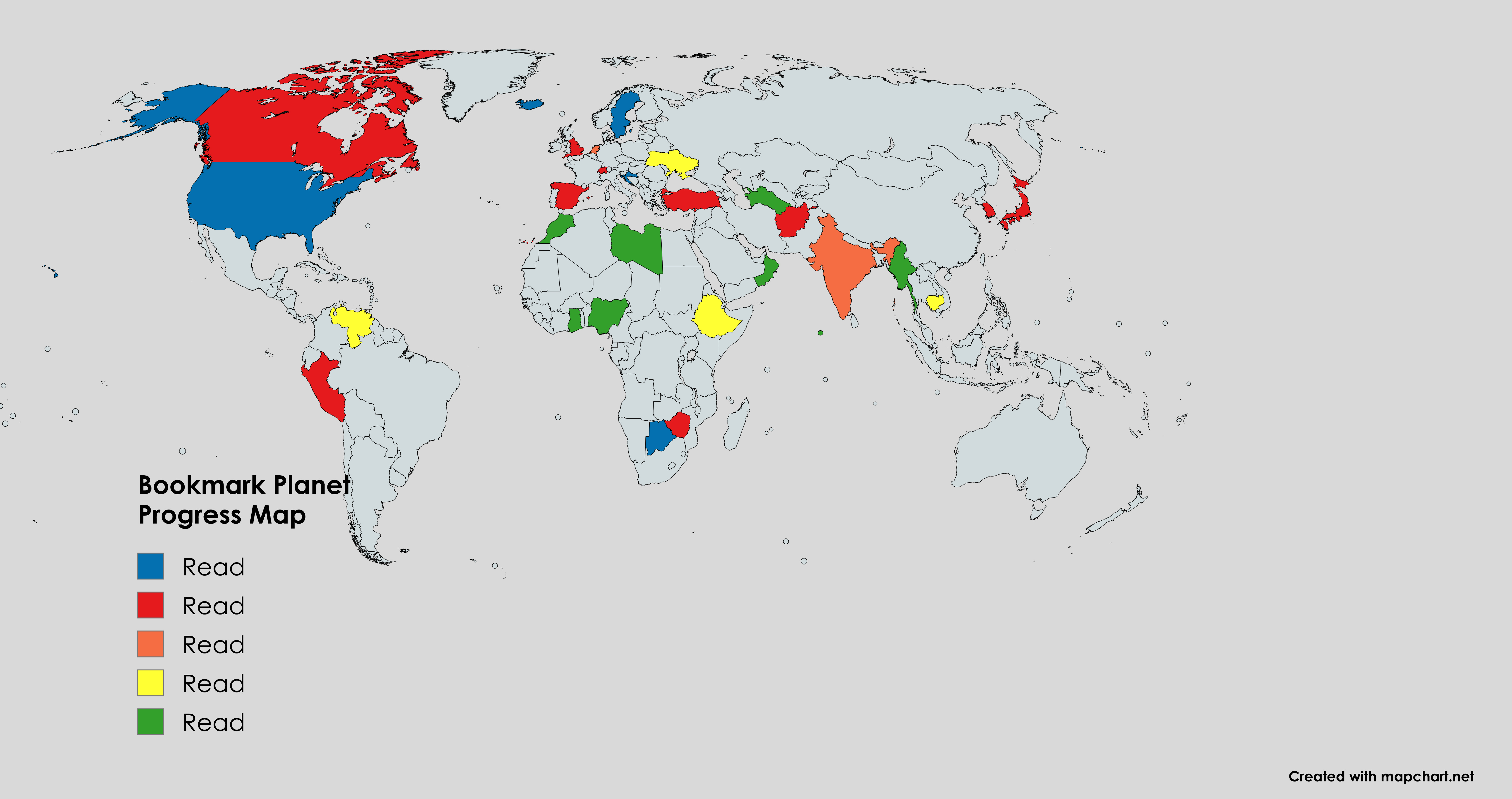
So what’s next? As you might imagine, I end up reading a lot of pretty bleak books dealing with war, strife, and civil unrest for this project, so I like to pepper in some lighter fare when I can. I’ve read a handful of detective novels along the way, and I’ve read and penciled in some science fiction as well. I haven’t read a lot of contemporary fantasy novels, and, since the whole point of this endeavor is to stretch myself a bit and get out of my reading rut, I’ve started one via audiobook: Zen Cho’s Black Water Sister, representing Malaysia. So far, it’s a perfect palette cleanser, and it’s so thoroughly engrossing I find myself firing it up even when I’m not commuting, so it’s accompanied me as I wash dishes and walk the dog, things I usually do in silence or with music.
More on that one when I finish. In the meantime, if anyone has a suggestion for a book from anywhere not shaded in my map, please don’t hesitate to let me know.