
Three the Hard Way
Or I Miss the Days When Books About Political Violence Seemed Exotic

It never ceases to surprise me how the haphazard way I pick the books for this project, driven mostly by the whims of my passing fancies and library availability, nevertheless seems to create patterns. I was all set to write about Anna Burns’ Milkman, the pick for Northern Ireland, when I got the notification that Ivana Bodrožić’s Hotel Tito, set in what is now Croatia amidst the fallout of the Balkan War, was available for checkout. Since they were both about lives marked by separatist violence, I decided to write about them together. Then, when I was done with the second of these very different but thematically linked books, I needed a break from civil war and partisan strife, so I opted for a bit of a palette cleanse with Canadian Ojibwe author Richard Wagamese’s snappy little horror novella Him Standing, which was short enough that I knocked it out in two days’ commute before I had a chance to sit down and write about the other two. And so it is that we’re knocking out three books for the price of one here.

In Gwendolyn Brooks’ People of the Book, which I read years ago and which probably planted the seed for this round-the-world reading project, a young character recalls what her father tells her about the ethnic separatist violence between Bosnians and Serbs. It’s not everyone on either side causing all this trouble, he reminds her, just the louts, which are, unfortunately, well-represented on both sides of any conflict. This is a good way to think about political violence; the vast majority of people everywhere, even those who have strong political, nationalist, or separatist leanings, are mostly content to just live their lives, take care of their families, and live in as much peace as they can manage. The trouble is that the louts amongst us, the loudest, dumbest, most hateful of us, have a way of ruining things for the rest of us.
This is on full display in Burns’ Milkman. The narrator here, who like everyone in this book has no name and is only referred to in code (her not-quite-official boyfriend is called Maybe Boyfriend, her three younger sisters are undifferentiated as Wee Sisters, and she mostly goes by Middle Sister and so on) just wants to read 19th century novels while walking around (the also unnamed) Belfast. But, since she lives in an insular neighborhood beset by the violence between UK government loyalist Protestants and Catholic Renouncers, The Troubles just will not let her be.
I’m beginning to miss the days when books like this one didn’t seem so damn prescient, but it’s hard not to draw parallels between Milkman, in which everything is politicized and over-scrutinized, and modern day America, which is increasingly beset by its own partisan divides and angry, shit-posting louts. Burns does a fantastic job here of showing us just how difficult it is escape the shackles of the time and place we inhabit. This is, of course, often even more difficult for women in societies that tend to devalue them. When a local Renouncer big shot known only as Milkman takes a shine to our protagonist, she has little choice in the matter. Even as she shuns his advances, the court of public opinion, which has already half-decided she is officially Beyond the Pale, a title reserved for those who show any eccentricities, decides that she is his mistress, and so she might as well be just that.
I loved this book for its unrelentingly obtuse and enigmatic language, and for the way it uses those attributes to explore the effects of living in the constant shadow of political violence. But what really got under my skin is the way it explores how oppressive it feels to live under constant surveillance from your neighbors. I haven’t lived in circumstances of such overt political strife as that seen in this novel, but it definitely resonated with me as the product of small town life and religious upbringing, in which any eccentricities are magnified and it’s easy to find yourself Beyond the Pale.
I suppose maybe I’m missing the point here in insisting on relating this novel set specifically during The Troubles to my own life. Certainly I learned more about that ugly bit of Irish and British history here. But I can’t say I walked away from it with any specific political take. While I sympathize with the plight of the Irish and might have Renouncer leanings if I’d grown up, as Middle Sister did, in a Catholic neighborhood in a divided Belfast, it’s hard to get behind any movement driven largely by louts, which this one is from both sides, at least as its presented in this book, and I definitely can’t get behind any movement that resorts to bombing innocent people just going about their lives. I’m just hoping that none of this gets any closer to home.

While it’s set in similar circumstances amidst the political upheaval and ethnic war that tore apart the former Yugoslavia, Bodrožić’s Hotel Tito couldn’t be farther from Milkman in style. While Milkman revels in playfully obtuse language experiments, Hotel Tito, named for the apartment building where its narrator, a young girl named, like the author, Ivana, is steadfastly straightforward, a work of matter-of-fact autofiction. In that regard, it reminded me of Vaddey Ratner’s Shadow of the Banyon, which is also drawn heavily from the author’s childhood experiences and war-torn existence.
The thing that interested me most about Hotel Tito is how remote the war seems for most of the book. Ivana is young when her family is displaced by the violence and moved into the titular hotel. While it continues to affect her family’s existence, this is best thought of as a coming-of-age story that just happens to be set in the aftermath of the war that splintered the former Yugoslavia into six separate nations. It’s a reminder of how the rituals and struggles of growing up are universal, even when our lives are torn asunder by violence.
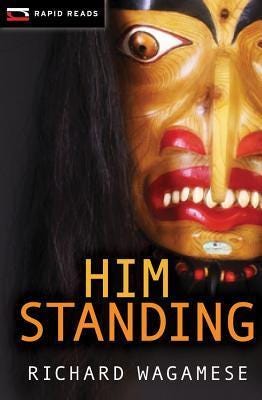
After back-to-back books about civil strife and ethnic violence, I wanted something a bit lighter. Queue Richard Wagamese’s novella Him Standing. I’d decided to slot a First Nations writer for Canada after reading about the plight of native children torn from their families and sent to live at state schools. Wagamese was an exceedingly prolific writer, and many of his novels seem epic in scope, historical fictions dealing with the struggles of First Nations people. Maybe I’ve sold him short here by slotting what is probably one of his more minor works as the book to represent Canada. But all human stories are important, not just the ones that explicitly lay bare the catastrophes and injustices of our times, and this one seemed to fit the moment.
Him Standing follows Lucas Smoke, a talented Ojibwe carver with a knack for rendering faces in wood. When a mysterious stranger gives him a wad of cash and commissions a mask with only the instructions to carve what he sees in his dreams, Lucas jumps at the chance. By the time he realizes he’s been tasked with bringing a powerful shaman who’s been imprisoned in the dream world into our world, it’s too late and he’s in mortal danger. The story that follows, drawn from Ojibwe folklore, falls somewhere between horror and magical realism, two of my literary loves. I don’t have a whole lot to say about this one except that I enjoyed the hell out of it and I definitely plan to read more of Wagamese’s work in the future.
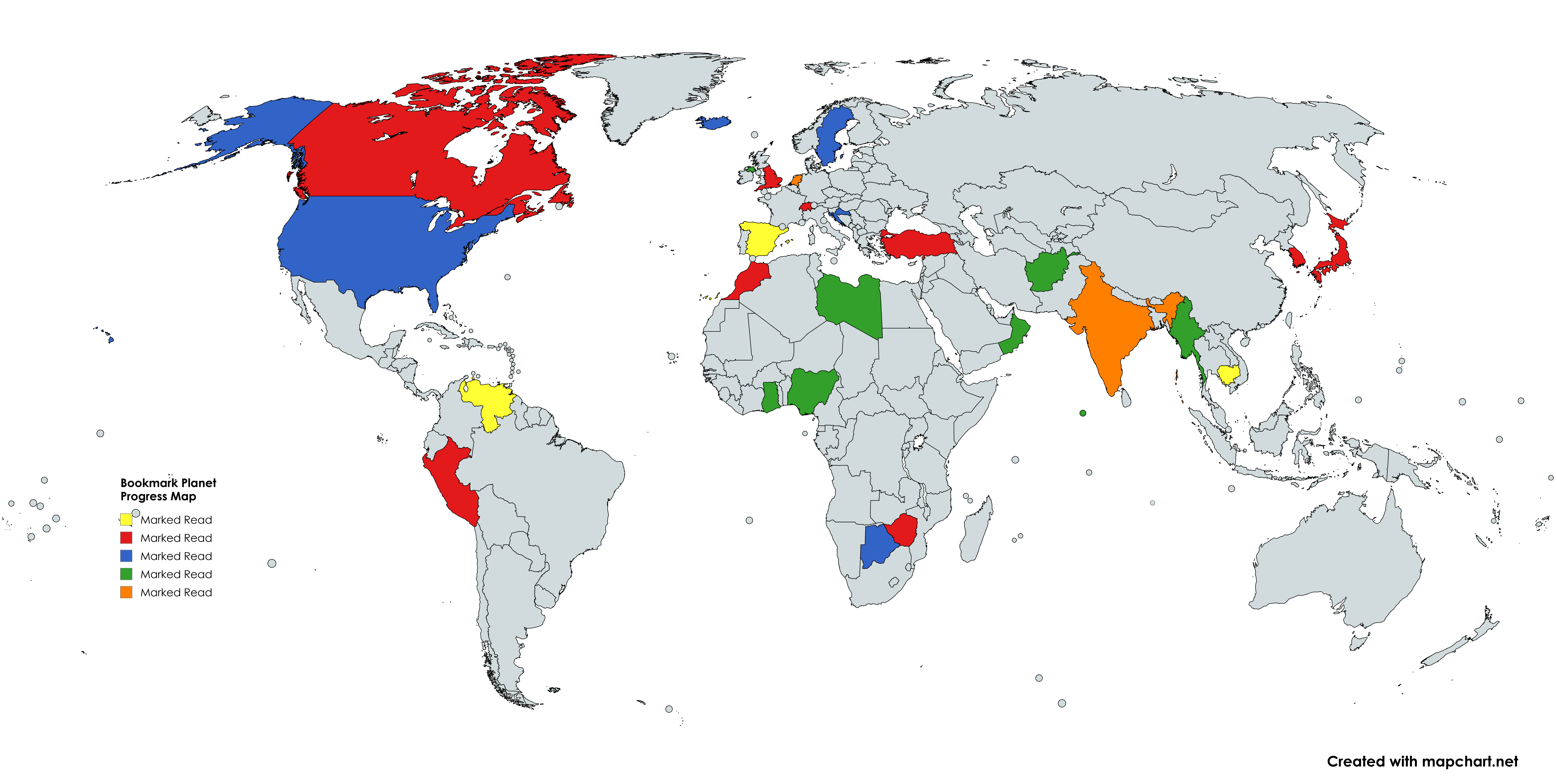
That’s going to have to wait, though, as I have quite a few countries left to go. For now, I’m still plugging (slowly) away at Les Miserables for France, and I’ve just started a new audiobook, Andrey Kurkov’s Jimi Hendrix Live in Lviv, which is representing Ukraine. Til then, keep reading and feel free to suggest books from anywhere that’s not yet shaded on the map above.
"The trouble is that the louts amongst us, the loudest, dumbest, most hateful of us, have a way of ruining things for the rest of us." - how depressingly true! Social media also unfortunately amplifies the voices of the village idiots who would've otherwise been previously ignored or shunned.