
The More Things Change
On reading Ak Welsapar's The Tale of Aypi, the pick for Turkmenistan

Last July, my son, a rising 7th grader, had a good bit of summer work to complete for his school program. Like pretty much everything in education now, his social studies summer work, which was all about maps, was heavily gamified. Basically, he had to fill out an online map of each continent as the names of countries popped up, and in order to pass, he had to do it inside a set time limit. He did this pretty easily with North America, South America, Europe, and with somewhat more difficulty, Africa. But he struggled for days trying to fill out Asia in under three minutes. When he finally asked for help, I bet him I could do it on the first try, only to be completely humbled and fail miserably.
When he said “Asia,” I was thinking China, Korea, Vietnam, Thailand, Japan and the like. I wasn’t banking on the Middle East being considered part of Asia, though that seems pretty obvious in retrospect. Even that would have been pretty straightforward if the global geopolitical map were the same as it was when I was his age, as anyone who’s plugged in to current events has at least a passing understanding of where Iran, Iraq, Saudi Arabia, Syria and Israel are on the map, right? What caused me the most grief was the plethora of former Soviet republics that were all just part of Russia back in my day. Sure, I knew where Georgia, Azerbaijan, and all the Stans—Uzbekistan, Tajikistan, Turkmenistan, Kazakhstan—were in a general sense, but it took a good while to learn which one was which, especially with the pressure of a ticking clock and smug twelve-year-old looking over my shoulder.
I thought about that map game a lot as I was picking books for all those former Soviet republics that have now been granted statehood. When it came to Turkmenistan, choosing a novel was a whole lot easier than mastering that map. When I read that Ak Welsapar’s The Tale of Aypi was supposedly the first novel to emerge from Turkmenistan, meaning of course, not that it’s the first Turkmen novel, but rather the first novel to be widely translated into English since Turkmenistan became its own country, the choice seemed clear.
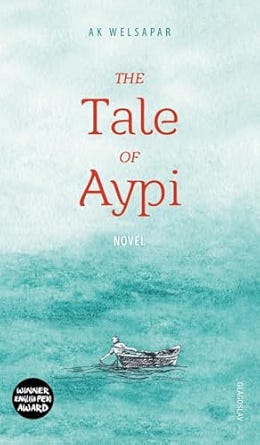
And a good choice it turned out to be. The Tale of Aypi is something of a modern fable that fits this project perfectly. Taking place during the Gorbachev era near the end of the Soviet Union, the novel is set in a small Turkmen village on the shore of the Caspian Sea. Soviet officials, intent on building a health spa in the area, have forbidden the men of the village to continue their traditional livelihood of fishing, promising that the entire village will soon be razed, its people moved to new lives and apartments in the city. One fisherman, Araz, insists on refusing this decree and continues fishing, making him something of a pariah in the village. The village’s woes are so heavy they awaken the ghost of Aypi, a woman who was sacrificed by the villagers’ ancestors for courting danger by accepting a ruby necklace from a band of mysterious outsiders generations ago.
Aypi, who has become something of a folk legend, is at first bewildered and confused by the modern conveniences of the village, but soon learns that the more things change, the more they stay the same, and that human nature has changed little in the century or so since her death. Enraged that men still treat women largely the same as they did in her day and that women still allow it, she sets out to exact revenge on the people of the village, who are themselves bewildered and confused by the lives led by their children and compatriots who have moved away to the city. It’s a clever little ghost story that draws on folklore to explore the ongoing battle of the sexes and a theme that pervades many of the novels I’ve read or penciled in for this project, the clash between traditional values and the persistent creep of modernity.
Another reason The Tale of Aypi fits this project so well is the way it reminds me just how vast the world is, even now as it’s seemingly getting smaller and smaller. After nearly a century as part of the Soviet Union, Turkmenistan declared independence in 1991, but, despite that independence, it’s carried on as a largely totalitarian state despite recent small inroads toward more open democracy. I don’t think it’s much of a stretch to say that Turkmenistan is fairly obscure on a global scale. I like to think I’m relatively well-versed in world affairs, but, as I learned in my son’s summer homework, I struggled to locate it on a map and knew next to nothing about it aside from the existence of the Door of Hell, a natural gas crater that has been burning for over fifty years, and come to think of, I may have thought that was in Tajikistan or Kazakhstan. Yet it’s home to nearly 8 million of the world’s people with a distinct culture and language. It’s a place I’m very unlikely to ever visit (hey, if you’re a rich patron who wants to pay me to visit these places from which I’m reading books, by all means hmu!) and one I likely wouldn’t have had many conscious thoughts about if I hadn’t picked up this novel. All that just underscores why reading widely is a good thing.
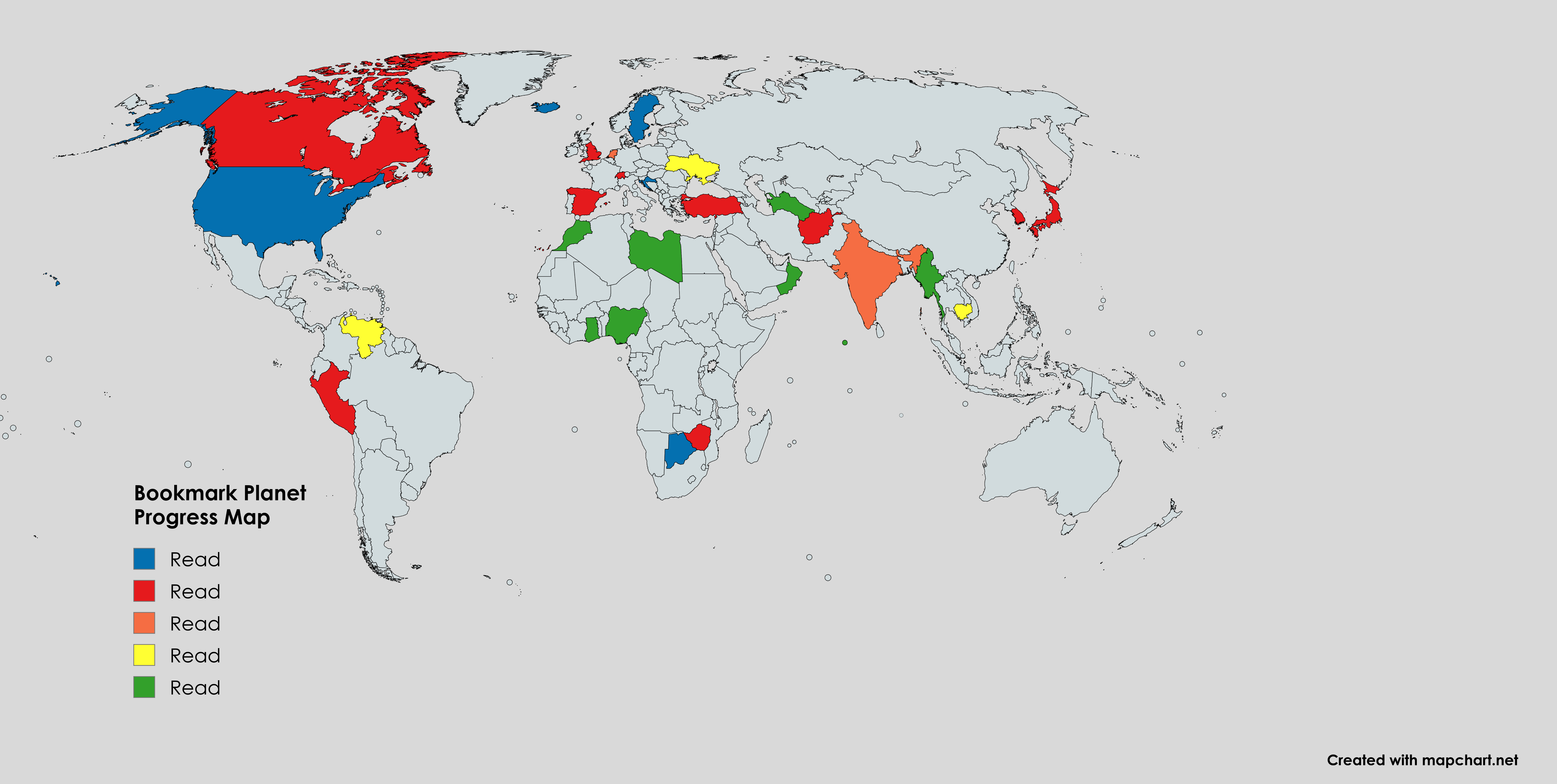
So what’s next? I picked up this short novel as a bit of a palette cleanser before I jump back into the gargantuan Les Miserables in earnest. I’m also plugging away at Maaza Mengiste’s The Shadow King via audiobook. As always, if you have a suggestion from any place not colored in on my map, let me know.
Until then, keep reading.
Hello to a fellow world reader! For Kazakhstan, I'd recommend Blood and Sweat by Abdizhamil Nurpeisov. It's a novel about the lives of Aral Sea fishermen, back when it was still a sea. One of my favourite Kazakh books, it gives you an idea of what it was like to be Kazakh during the Soviet civil war in 1918-20.
Thank you for this. Your reading journey is fascinating. I've always loved geography. New Zealand appears open, so there's Janet Frame books, of which I have not read any despite loving the film An Angel at My Table.