Still Awaiting Content Moderation
On reading the Dutch entry, Hanna Bervoets' We Had to Remove This Post

My son is twelve right now, a magical age when flag football touchdowns seem epic and you’re just starting to figure out who you are, or at least who you might be. It’s also an age fraught with a whole lot of bullshit. You’ve just begun a truly bizarre body horror transformation, a slow-motion timelapse into some sort of gangly, confused werewolf. And, oh yeah, you have to navigate all this in a sea of other gangly, confused monsters with whom you’re trapped for eight hours a day.
Twelve is the Charles Dickens of life stages: it’s the best of times, it’s the worst of times. Like everyone reading this, my memories of being twelve are half-wonderful and half-terrible, often for reasons that are laughable now but seemed serious as the grave while I was living them. It’s a difficult age, harder for some than for others, but complicated and bewildering for all. I think it’s a great deal harder for this generation, native to the internet age. The world wide web is a Pandora’s Box of knowledge and inanity, information and dis/misinformation, and porn. So much porn, more porn than our twelve-year-old minds, blown away by a pilfered copy of Penthouse, could ever even imagine.
I worry about my kid wandering around in the world—the real world and the increasingly omnipresent virtual one—trying to make heads or tails of everything it has to offer. Of course we monitor him, but there’s only so much sheltering you can do before it becomes weird and overbearing, and ultimately he’s going to have to live in these worlds. It’s something that’s been weighing on my mind recently, so it’s no surprise I selected Hanna Bervoets’ We Had to Remove This Post as the Dutch selection.
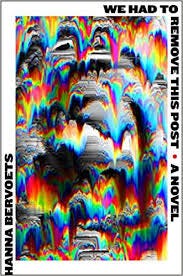
We Had to Remove This Post, narrated in the form of a letter to a lawyer, follows Kayleigh, whose work as a content moderator for a huge social media platform starts to have real-world consequences as the bombardment of images and videos showcasing the absolute worst of humanity she’s inundated with at work erode her psyche. My only real complaint with this book is that the exploration of the working conditions and psychological fallout of being a content moderator mostly take a backseat ; this is, at its heart, a novel about the toxic relationship between Kayleigh and her co-worker Sigrid. I suppose those two themes are inextricably linked, so it’s not too big of a complaint.
I guess I already had a decent understanding of how fucked up the internet can be when it comes to giving desperate, hateful, or just plain bored people a platform, so I found the exploration of those themes a bit underwhelming. What interested me most about this book was that it seemed so universal, the setting so banal that if I hadn’t known that it was translated from Dutch and it was ostensibly set in the Netherlands, I may have listened to the entire audiobook thinking it was Anywhere, USA, some faceless city in the midwest. Some of this is no doubt due to Kristine Hvam’s narration, which is rendered in un-accented American English. But it also seems conscious on Bervoet’s part as well, as descriptions are kept intentionally vague. At the sports bar where Kayleigh hangs out after work, “the game” is on. I imagined it to be UEFA league soccer, but it just as easily could’ve been Monday night football. Late in the novel, she travels to “a medium-sized seaside city,” not some specific Dutch location. The effect is the exact opposite of my Japanese pick, Akira Otani’s The Night of Baba Yaga, which is also rendered in contemporary English but retains a distinctly Japanese flavor. This attempt to scrub specifics away from a story so intimately connected with the internet, a homogenizing force threatening to pave over the world, is a stylistic choice meant to underscore the themes, as the things Kayleigh can’t unsee can be seen by content moderators all over the world, but it’s still a bit frustrating.
Another way this one fell into my lap at the right time has to do with its length. As you might imagine, facing a daunting reading list like this one makes one appreciate short, tight little novels. I have several huge tomes waiting for me. Les Miserables, penciled in for France, weighs in around 1500 words, roughly the same length as the Bible, and I’m currently in the middle of Marlon James’ A Brief History of Seven Killings, which must be a doorstop in hardcover form because the audiobook is almost twenty-eight hours long. As is often the case with books—especially audiobooks—that long, I needed a break at halftime. We Had to Remove This Post, with its snappy run time just under three hours, came along as a short, easily-digested side quest. I’m glad it did. I can’t say it offered much in the way of solace about helping my son navigate the dark seas of the internet or the world in general, but its good to know I’m not alone in that angst.
In the works we have the representative from Spain, Cela’s The Hive, which I’m working through slowly, and Fernanda Melchor’s Hurricane Season, representing Mexico. It was supposed to be my Halloween selection, but the library hold system had other plans, so I’ll be starting it as the pumpkins give way to Christmas Trees.
Y’all keep reading.