
Back in the Saddle
Three for the price of one: Orhan Pamuk, Nu Nu Yi, and Ibrahim Al-Koni

December was rough. My wife and I were in a wreck that left her out of work for six weeks. On top of that, when they did a CT scan in the ER to rule out internal injuries, the doctors found what they originally thought was a tumor in her stomach. After an agonizing and worrisome stay in the hospital waiting for an endoscopy, we found out it was actually a hiatal hernia, which was obviously much better news. I kept reading through all of this, but I just couldn’t really get into the headspace to write about the books I was reading here until now.
The rough patch had actually started weeks earlier, back around Thanksgiving, when we got the tragic news that our neighbor’s grandson, one of my son’s best friends, had committed suicide at age 13. The kid, a fixture in our lives for most of his life, was at our house shooting basketball with me and my son on Friday afternoon. Monday morning he was dead. I can only imagine the pain his immediate family has experienced, so I don’t mean to compare our sorrow to theirs, but, because my son is around the same age, the kid’s death hit my wife and I hard. It also forced me to think about the things my son has to deal with out in the world, bringing the helplessness that comes with knowing there are some things you can’t protect your children from no matter how hard you try into sharp, bitter focus. Maybe that’s why the first of the three books I’ll write about here connected with me.
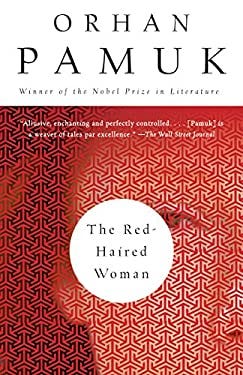
The selection from Turkey was a bit of a no-brainer. I’d been meaning to read Orhan Pamuk, a Nobel Prize winner, for some time, so this project seemed like a good time to finally cross him off the old TBR. As for the book selection, I left that to the winds of fate. I had a few of his books on my favorites list in Libby, one of the library apps I use for e-books, and when I was ready for my next read, his 2016 novel The Red-Haired Woman was the only one available. I’ve written here before about how sometimes the universe seems to send us books at the right time. This was one of those cases. Just as I was deep in my thoughts about my son in the wake of the tragedy, this book about fraught father-son relationships fell right into my lap.
There are so many layers to those kinds of relationships in The Red-Haired Woman. Our protagonist, Cem, is estranged from his mostly-absent, political dissident father. When he takes a summer job as a well digger’s apprentice, he takes on another father figure in the form of his boss, Mahmut, whom he ends up betraying in shocking fashion. Those layers get even more complex when Cem has to deal with his own troubled son. Further enriching all this exploration of father/son dynamics are the threads of two myths running in the background with eerie parallels to the story. Cem is obsessed with the myth of Oedipus, in which a son is fated to kill his father, and the sort of Oedipus-in-reverse Persian myth of Rostam and Sohrab.
I sincerely hope I never have to deal with the exact kind of father/son stuff that goes down in this book, but I know firsthand how difficult and thorny these relationships can be, so I appreciated the exploration of them here. I’m also a sucker for mythology, so the exploration of the familiar Oedipus story and the new-to-me Persian mythology was interesting as well. I’m told that this isn’t the best place to start with Pamuk, as it’s apparently a stylistic outlier not very typical of his work, but I loved this book. Some books stick with you for a long time. This is one of those. The emotional imprint of The Red-Haired Woman will resonate with me long after the details of the plot fade somewhat in my memory.
Not all books can hit that hard. The follow-up read, Nu Yi’s Smile as They Bow, the pick for Myanmar, is likely to slide right off rather than stick. That’s not necessarily a slight; I’m sure there are many readers who will find this book at the right time, just as I did with The Red-Haired Woman. Yi’s novel is set during the Taungbyon festival honoring the Nats, local spirits in Burmese tradition. The novel, based loosely on a true story, follows Daisy Bond (real name, U Ba Si) a gay transvestite medium who makes a living doing spiritual performances for the throngs of people flocking to the festival. I appreciated this one from a cultural standpoint; I knew absolutely nothing about this festival and very little about Mynamar beyond the international headlines going in to the book, so it represented a peek inside a culture that was completely foreign to me.
Aside from that, this one fell a bit flat for me. I love the exploration of how the festival gives gay men a place in a society in which they’re marginalized, but Daisy’s relationship with his young lover/assistant was problematic for me. Maybe I just had a hard time taking off my own cultural lens to see it in its true light, but either way, I found it a bit difficult to connect with the characters here.
Finally, there was Ibrahim Al-Koni’s Gold Dust. I chose this one because it was described as a Libyan Western, which seemed intriguing. Though it’s not as bleak or relentlessly violent as Blood Meridian, it might be best thought of by American readers as more of a Cormac McCarthy Western than, say, a Louis L’Amour Western. Sparse and lyrical, concerned mostly with being a spiritual parable, Al-Koni’s story about a man obsessed with his camel, a rare piebald specimen with a wild streak, is a quick read.
It’s also a good example of the kind of book I didn’t understand, at least as I was reading it. Though it seems obvious now, it’s largely an allegory about the Sufi understanding of sin, something that was lost on me until I did a little digging after finishing the novel. Luckily, it worked on both levels, as I was intrigued by the story, which says a lot about Al-Koni’s writing, as the story can mostly be summed up as being about a man following and searching for his lost camel in the desert. The allegorical stuff added a layer of complexity after the fact and I wonder how it would have affected my reading if I’d known more about it going in.
I guess we’ll never know.
So what’s next? As is my usual modus operandi, I have two books going at once, one via audiobook for the endless commute, and one in print form. Pettina Gappah’s Out of Darkness, Shining Light, the Zimbabwean pick currently riding shotgun with me to and from work, seems tailor made for this project, an account of Dr. Livingstone’s life and death as told by the natives who accompanied him on his journey and carried his remains across Africa. Obviously colonialism is an important theme in this project, and it would be difficult to find a book that deals with it more directly. I’m also reading Victor Hugo’s Les Miserables, an absolute brick of tome at around 1300 pages. Luckily I’m doing that one along with a small group of reader friends including my wife, so it’s not quite so daunting as tackling it alone.
Until next time, keep reading.
I have read Pamuk but not The Red Haired Woman. It is on my list now. As is the Zimbabwean Out of Darkness Into Light. And your thoughts on finding the right book at the right time resonated with me tonight. As I was listening to Dickens’s Bleak House today , I thought how his novels effected change. Is anyone out there writing a big novel about our government’s brutality and indifference today. Maybe the days of a novel’s universal influence are over, but I will be waiting for the book.